

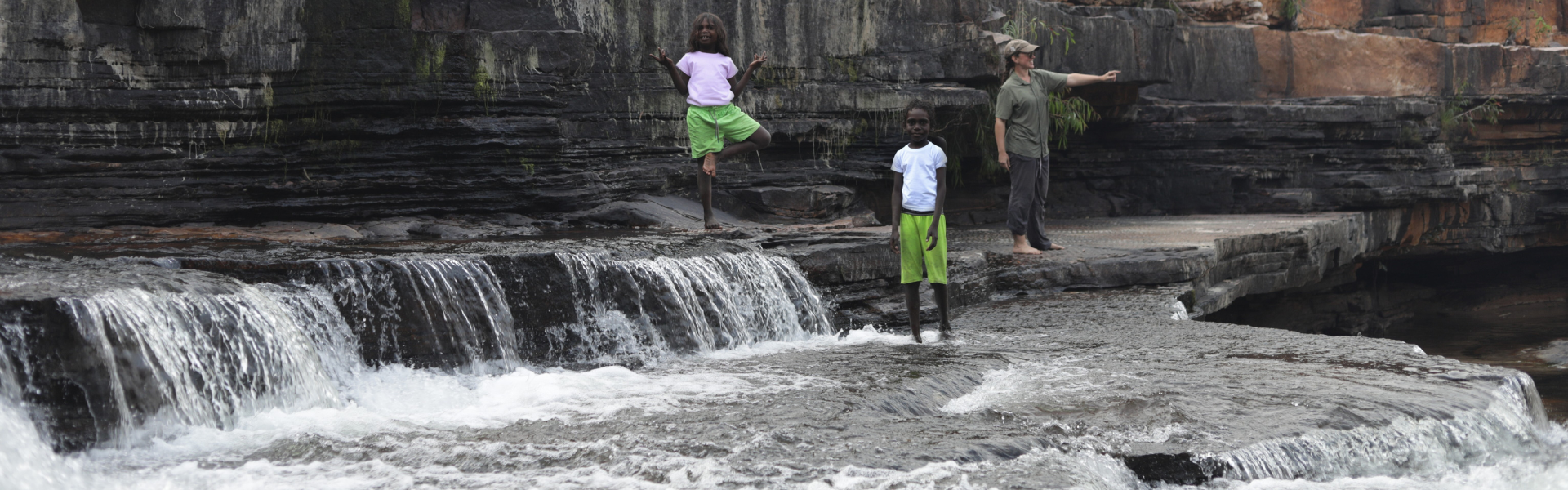
Our inclusive, kin-centric employment model celebrates family-based learning experiences, supports families to be actively involved in children’s educational journeys, and ensures that the classroom is always a welcoming and supportive place.
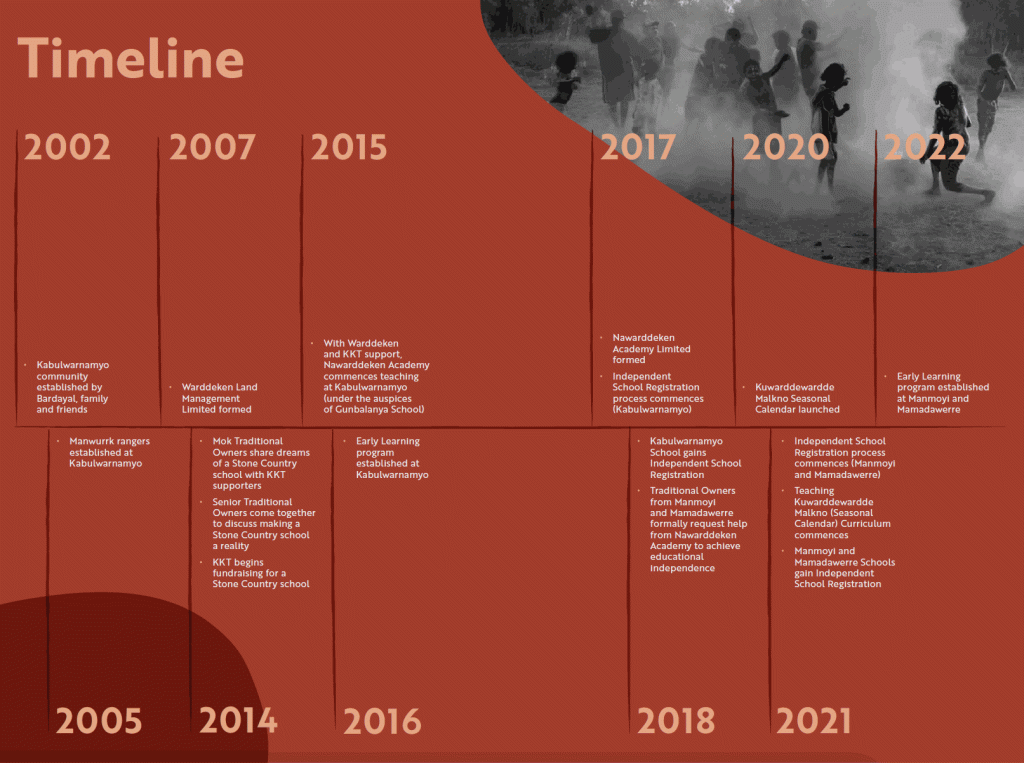
In 2014, community members and Elders sat down to talk about what they wanted a school to deliver for the young people of the Stone Country, and the unique opportunities establishing a school on Country presented. These conversations, community consultations and workshops led to the development of Objectives and Guiding Principles that reflect the aspirations of Nawarddeken Traditional Owners. They provide a clear foundation for what the Nawarddeken Academy will achieve.
For some years, rangers and Traditional Owners lobbied for fulltime education to be delivered on country, so they would not have to make the difficult decision to either leave their homelands or send their children away to live with family in larger towns to access schooling. Elders and parents dreamed of two-toolbox education to make their children strong in two worlds – Bininj and Balanda.

Thanks to Nawarddeken Academy, our children are now receiving a first-rate education on Country. Our bi-cultural education approach engages Indigenous leaders, rangers and skilled teachers. The future of Bininj Nawarddeken depends on our children learning to live, work, and thrive within two knowledge systems. By equipping kids with the knowledge and skills to do so, Nawarddeken Academy are ensuring that the future of west Arnhem Land is strong.
Timeline

2017
August
The Academy applied for Independent School Registration.
2018
March
Manmoyi (MMY) and Mamadawerre (MDW) asked for NAL’s assistance to set up independent schools.
2018
March
Request for help resulted in NAL board resolving to support MMY and MDW on their journey to independence.
2018
June
Our application for Kabulwarnamyo was rejected. NAL appealed the decision.
2018
December
The Nawarddeken Academy was registered as an independent school starting Jan 2019, funded by KKT.
2019 - 2020
December
TO’s invited to NAL Board meetings as observers, independent consultations and NLC Section 19 ALUA’s to establish a strong argument for community support and LDM.
2021
March
Submitted applications for the registration of independent schools at MMY and MDW.
2021
September
The Registrar notified NAL of the successful registration
2021
September - October
Manmoyi and Mamadawerre officially registered
2024
August
Submitted applications for the registration of a secondary school
2025
January
The Registrar notified NAL of the successful registration of the Kunmayali (secondary) school, in time for the 2025 school year
Guiding Principles

Respect, and the ability to integrate customary modes of learning guided by our old people with a ‘western’ educational curriculum
Facilitate a unique curriculum based on our land, language and culture, using formal and informal teaching and learning approaches, emphasising mental and physical health, while cultivating individual and collective respect and responsibility
Incorporate flexibility, enabling continuous improvement and positive responses to changing circumstances
Access all available technology to overcome the disadvantage of our geographical remoteness, and to ensure our resilience
Recruit, support and retain high-quality staff underpinned by strong leadership and competent
Governance
Support the Nawarddeken Academy